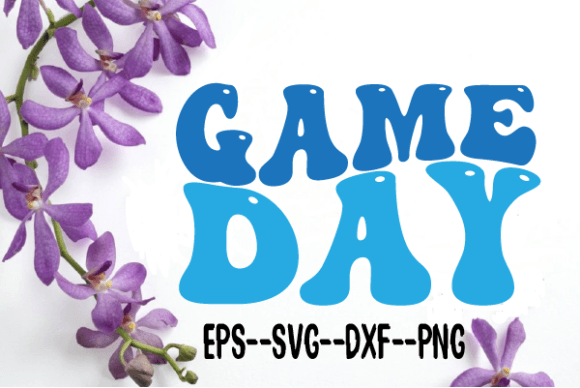
Gameday New Wavy Retro Svg Sublimation
First Impressions: A Nostalgic Pulse with Practical Limits
When I opened Gameday New Wavy Retro Svg Sublimation, I felt that familiar jolt of retro energy—bold curves, rhythmic undulations, and a playful, almost kinetic layout. It’s not just “vintage-inspired”; it carries the warmth of 80s arcade posters and stadium banners, but distilled into something clean enough for modern craft business use. As an embroidery designer who tests dozens of digital embroidery files each month, my first question isn’t “Is it cute?”—it’s “Where will this actually stitch well—and where will it fight me?” This design leans heavily into sublimation aesthetics: smooth gradients implied by shape, minimal internal detail, and strong silhouette presence. That’s both its strength and its signal—it wasn’t built *for* dense satin-stitch coverage or tiny lettering.
A Real-World Test: Embroidering It on a Cotton Canvas Tote Bag
Last week, I prepped a batch of custom tote bags for a local boutique’s back-to-school launch. Their request? “Fun, sporty, but not childish—something that feels handmade, not mass-printed.” I chose Gameday New Wavy Retro Svg Sublimation as a base, then adapted it for machine embroidery—not by tracing the SVG directly, but by reinterpreting its flow in stitch-friendly terms. The wavy contour translated beautifully into a bold running-stitch outline (3mm width), with open negative space filled using a low-density fill stitch at 12% density. On medium-weight canvas, it held crispness without puckering. Customers responded immediately: “It looks like it was drawn by hand,” one said. That’s the gold standard for a handmade product—the design supports, rather than overshadows, the tactile quality of embroidery.
Where It Shines (and Where It Steps Back)
Gameday New Wavy Retro Svg Sublimation works best when treated as a *graphic anchor*, not a standalone embroidery file. For sweatshirt embroidery, it’s ideal as a chest accent—large enough to read from across a gym, simple enough to avoid thread buildup. On pillow covers or tea towels, its rhythm echoes fabric weave patterns, giving cohesion without visual noise. As a holiday embroidery motif on a knit baby blanket? Yes—if scaled to 3.5" wide and stitched with soft pastel threads, it reads as cheerful, not chaotic.
But here’s what I’d flag for fellow Etsy sellers and small shop owners: this isn’t a plug-and-play embroidery file. It arrives as DXF and EPS—formats built for vector cutting and sublimation, not native embroidery software. You’ll need to digitize it yourself or hire a digitizer. Don’t assume the wavy lines will translate cleanly to satin stitch without adjusting underlay, pull compensation, and stop points. On stretchy fabric like jersey tees or curved cap fronts, un-digitized waves can distort or skip. And on dark fabric? Its light-based retro palette won’t pop unless you add a white underlay layer—something the original files don’t include.
Design Integrity Meets Commercial Reality
What makes Gameday New Wavy Retro Svg Sublimation valuable for creative entrepreneurs isn’t just its look—it’s how it invites intentionality. Unlike over-rendered clipart, its simplicity forces you to consider thread color contrast, stabilizer choice (I used tear-away + light cutaway for the tote), and even customer expectations. A buyer ordering a personalized gift expects clarity, durability, and that subtle “designed-for-you” feel—not pixel-perfect replication of a sublimation graphic. When stitched thoughtfully, this design elevates perceived value: it reads as curated, not generic. That builds trust, especially for boutique branding or craft fair products where handmade presentation matters more than flash.
Practical Designer Notes Before You Stitch
- Always test on scrap fabric first—especially if using textured weaves or blends. The wave’s rhythm can catch on loose threads.
- Check thread color contrast on both light and dark mockups. What reads as vibrant in RGB may fade on navy twill.
- Review stitch density if digitizing yourself. Avoid >15% fill in large areas—heat and wear will show faster.
- Confirm hoop size compatibility. The full wave spans ~5.2" wide; ensure your frame accommodates it comfortably.
- Inspect small details—there are no fine serifs or micro-edges here, but verify corners don’t create tight stitch clusters.
- Test black-and-white mockups to assess readability at smaller scales (e.g., for baby embroidery or cap side panels).
- Use proper stabilizer: medium-weight cutaway for knits, tear-away for stable cottons, and always float the top for delicate layers.
- Verify licensing before selling finished products or bundling the file with other design assets. Since it’s labeled as a Graphics product for Crafts, confirm commercial use rights with the seller.
Final Thought: A Design That Asks You to Engage
Gameday New Wavy Retro Svg Sublimation isn’t background music—it’s a conversation starter. It doesn’t beg for attention; it earns it through confident shape and mood. For embroidery designers, it’s a reminder that great design assets aren’t always about complexity. Sometimes, they’re about leaving room—for thread, for texture, for the person holding the finished product. Whether you’re stitching a custom apron for a coffee roaster, a holiday embroidery set for a nursery brand, or a limited-run patch for a community sports league, this design gives you rhythm, nostalgia, and a solid foundation—provided you meet it halfway with thoughtful digitizing and real-world testing. That balance—between retro spirit and embroidery practicality—is exactly what makes it worth your time.