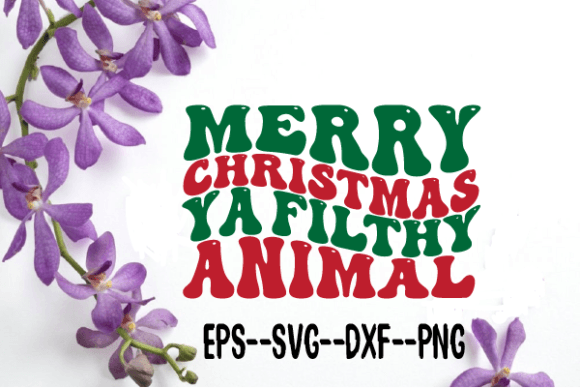
Merry Christmas Ya Filthy Animal Wavy
As someone who’s stitched holiday designs on everything from organic cotton onesies to heavyweight denim aprons, I opened Merry Christmas Ya Filthy Animal Wavy expecting playful irony—and got exactly that, with a side of real-world embroidery nuance. This isn’t just another retro phrase slapped onto a vector grid. It’s a mood, a wink, and a design that demands thoughtful execution—not just automatic digitization.
First Impressions: Retro Charm With Real Stitching Consequences
The wavy layout immediately signals mid-century kitsch—think vintage soda shop signage meets cheeky holiday card energy. The letterforms have generous curves, open counters, and intentional spacing. That’s great for sublimation or print—but in machine embroidery, those wide arcs and thin connecting strokes translate directly into stitch behavior. On first glance, I pictured this on a relaxed-fit unisex sweatshirt: soft fabric, medium-weight stabilizer, tonal thread (charcoal gray on heather navy), and a 4”–5” hoop. It felt right—casual, confident, and unmistakably handmade.
Where It Shines (and Where It Stumbles)
Merry Christmas Ya Filthy Animal Wavy works best when the product matches its personality: laid-back, humorous, and slightly irreverent. It’s ideal for:
- Embroidered tote bag designs—especially natural canvas or heavy cotton duck, where the wavy line flows with the drape
- Sweatshirt embroidery on brushed fleece or French terry, where stitch definition stays clean without looking stiff
- Pillow covers and kitchen towels—fabrics that hold shape well and let the design breathe visually
- Custom apparel for small shops or Etsy sellers targeting 25–40-year-olds who appreciate dry humor and tactile quality
- Holiday gifts like embroidered aprons for bakers or baby blankets (with careful font scaling—more on that below)
But it’s not universally forgiving. That same wavy rhythm becomes tricky on curved surfaces like caps or beanies—where distortion pulls letters out of alignment unless you’re using a cap frame and adjusting underlay accordingly. And on stretchy fabrics (like ribbed knits or lightweight jersey), the lack of tight internal structure in the letterforms means satin-stitched edges can pucker or shift without precise tension control and cutaway stabilizer.
Small Details Matter More Than You Think
The “Y” and “A” in “Ya” are narrow and tall. In fill stitch, they risk looking fragile or losing legibility under 3” hoop sizes. I’d avoid stitching Merry Christmas Ya Filthy Animal Wavy smaller than 3.75” wide on anything but stable, low-texture fabric. On baby onesies? Scale up to 4.25” and use a lightweight tear-away + iron-on hybrid stabilizer—otherwise, the delicate curves may vanish in the stitching.
Also worth noting: this is a graphics file—not a pre-digitized embroidery file. So if you’re an embroidery designer or craft business owner, you’ll need to digitize it yourself or hire a digitizer familiar with retro type treatments. Don’t assume the SVG will stitch cleanly straight out of the hoop. The wave effect relies on smooth vector paths, and poor digitizing can turn graceful arcs into jagged, over-stitched messes.
Real-World Use Case: A Boutique Tote Bag Launch
Last week, I prepped Merry Christmas Ya Filthy Animal Wavy for a local gift shop’s limited-run holiday tote. We used 12-oz natural canvas, medium cutaway stabilizer, and matte polyester thread in forest green. The result? Warm, textured, and instantly recognizable—but only because we tested three versions first: one with tighter satin stitch angles, one with reduced stitch density in the curves, and one with added underlay on the outer wave peaks. The winning version had subtle lift at the topmost curve—enough to catch light, not enough to snag.
Customers responded strongly—not just to the humor, but to how *intentional* it looked. That matters. A rushed or poorly stabilized Merry Christmas Ya Filthy Animal Wavy reads as lazy. A considered one reads as curated. For Etsy sellers or handmade shop owners, that distinction affects perceived value, repeat orders, and word-of-mouth trust.
Practical Designer Notes Before You Stitch
Before committing to your first finished product:
- Test the design on scrap fabric matching your final product’s weight, weave, and stretch
- Check thread color contrast—not just on white, but on your actual dark or heathered base fabric
- Review stitch density: too dense = stiff, shiny, and prone to cracking; too sparse = weak definition and fraying risk
- Confirm hoop size compatibility—especially if using multi-position hoops or cap frames
- Inspect small details like inner counters (“e”, “a”, “o”) in both black-and-white and color mockups
- Compare performance on light vs. dark backgrounds—some retro palettes lose impact on black fabric without adjusted underlay
- Use proper stabilizer: cutaway for knits, tear-away for stable wovens, and fusible for lightweight or sheer layers
- Verify licensing terms before selling finished items or bundling the digital file—it’s listed as a Graphics asset, not an embroidery-ready commercial-use pack
Final Thought: Personality Needs Precision
Merry Christmas Ya Filthy Animal Wavy isn’t background noise. It’s a statement—and statements deserve care. It fits perfectly in a Crafts workflow where humor meets craftsmanship: holiday embroidery that feels personal, not mass-produced; custom apparel that starts conversations; and handmade products where the stitch tells part of the story.
If you’re an embroidery designer, Etsy seller, or small shop owner building a brand around authenticity and wit—this design has legs. But only if you treat it like what it is: a strong visual idea that earns its place on fabric through smart digitizing, smart stabilizing, and smart scaling. Not every retro phrase survives the needle. This one does—when given the respect it deserves.